The Best TrainingPeaks Alternative in 2026: augo vs TrainingPeaks for Endurance Coaches

Short answer: TrainingPeaks is the best tool in endurance sport for modelling training load. augo is the best tool for understanding athletes. If your coaching decisions come down to CTL, ATL and TSB, stay on TrainingPeaks. If your coaching decisions come down to how an athlete slept, how the session actually felt, what they told you on Tuesday and what the numbers say — and you want AI doing the reading for you — augo is the TrainingPeaks alternative you're looking for.
First, the thing everyone's asking about: Garmin bought TrainingPeaks
On 22 July 2026, Garmin announced it had acquired TrainingPeaks and TrainHeroic. All 120 employees were retained, terms weren't disclosed, and TrainingPeaks' managing director said the platform "will continue to operate as a cross-platform ecosystem."
It's worth, however, naming the honest open question, because it's the reason a lot of you are reading this page: a hardware manufacturer now owns the neutral coaching layer that Wahoo, Coros, Polar and Suunto athletes all sync into. Garmin has committed to cross-platform support in principle, not in writing. If half your roster is on non-Garmin devices, "we intend to remain cross-platform" is a statement you'd reasonably want a second option behind.
That's the practical case for knowing what else exists. Here's the honest version. If you want the deal itself rather than the comparison, our CEO wrote a longer piece on what Garmin's acquisition of TrainingPeaks means for coaches, including the principles augo commits to in response.
Why coaches start looking for a TrainingPeaks alternative
Almost nobody leaves TrainingPeaks because the analytics are bad.
Coaches leave for a different reason, and it's usually some version of this: the platform is very good at telling you what an athlete did, and close to useless at telling you how they're doing.
You know the pattern. Twenty athletes. You open the calendar on Monday morning and start at the top of the alphabet. Somewhere around athlete nine your attention starts to thin out. The athlete with the real problem is athlete sixteen, and the fatigue signal isn't in her power graph. It's in the WhatsApp message she sent on Thursday, the "legs felt heavy again" comment on Saturday, and the fact that she's mentioned the same knee twice in three weeks. Three of those live outside your training platform entirely.
That's the gap. Not analysis, but attention.
The second reason is more mundane: the interface. TrainingPeaks was built in an era when coaching happened at a desktop, and it still shows. The information density is a feature if you're deep in a Performance Management Chart on a 27-inch monitor. It's a problem if you're trying to review an athlete on your phone between sessions. Planning or adjusting sessions on the phone? Forget it. That's not possible.
What TrainingPeaks is great at
Let's be straight about this, because a comparison that pretends the incumbent is bad isn't worth reading.
TrainingPeaks has the deepest, most mature training-load model in endurance sport. The Performance Management Chart — Fitness (CTL), Fatigue (ATL) and Form (TSB) — is the industry reference for periodisation, and it has two decades of coach literacy behind it. TSS is a shared language. The workout builder is thorough. The plan marketplace is the biggest in the sport. WKO sits alongside it for coaches who want to go further into modelling than any other product allows.
If you are the coach who plans a season on the PMC, who wants to see a peak power curve against last year's, who thinks in terms of ramp rate and taper modelling — TrainingPeaks is built for you, and augo is not trying to take you. That coach exists, they're excellent at their job, and they should stay.
augo is built for a different coach.
Who augo is built for
augo starts from a different premise: the limiting factor in modern coaching is not analysis, it's the coach's attention and time. So the product is designed to find what matters and put it in front of you, rather than to give you more surface to search.
Athlete Signals: the roster triaged before you open your laptop
Every morning, augo reads the last seven days for every athlete on your roster — their workouts, their subjective session feedback, and your conversations with them — and produces a list of signals you shouldn't miss. Injury and niggle patterns. Motivation dips. Fatigue that doesn't match the prescribed load. Scheduling requests and open questions buried in a chat thread.
You open augo and you're not looking at an alphabetical list of twenty athletes. You're looking at the four things that actually need you today. We've written up how we decide which athlete needs your attention — what counts as a signal, and what deliberately doesn't.
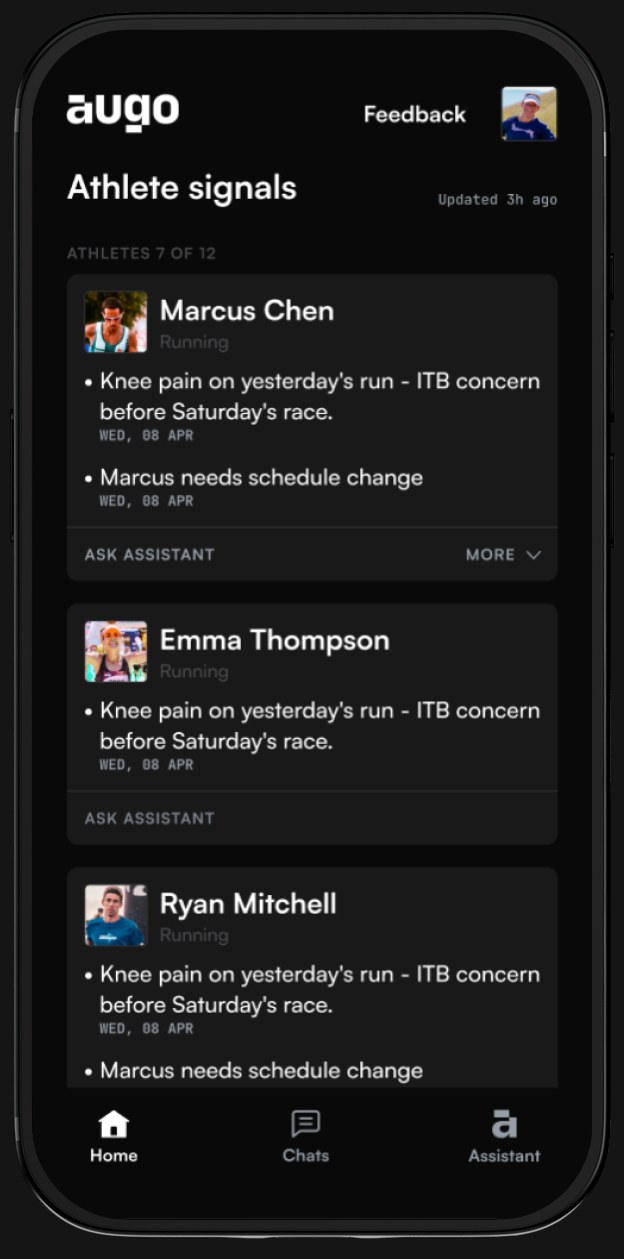
The design goal is blunt: if you only handle what's in Athlete Signals, you've done a good job that day. Everything else is noise, and noise is what burns coaches out at scale.
An AI assistant with the whole picture
augo's assistant works like talking to ChatGPT or Claude, except it already has your coaching context loaded. It can read:
- every workout and its underlying data
- every post-session subjective report your athletes have filed
- every coach–athlete conversation
- performance anchors — threshold values, zones
- your private coach notes, which athletes never see
That last one is the difference between a chatbot and an assistant. The context that makes you a good coach — "she always undersells fatigue", "we're being cautious with that Achilles" — lives in your head and in your notes. augo's assistant reads it, so its answers are your coaching, faster.
Ask it across your whole roster ("who's showing the same fatigue pattern as last month?") or about one athlete ("summarise the last three weeks and tell me what you'd change"). It drafts too: check-in messages, workout comments, weekly summaries, proposed plan adjustments. And it takes actions — it can create notes and record performance anchors for you.
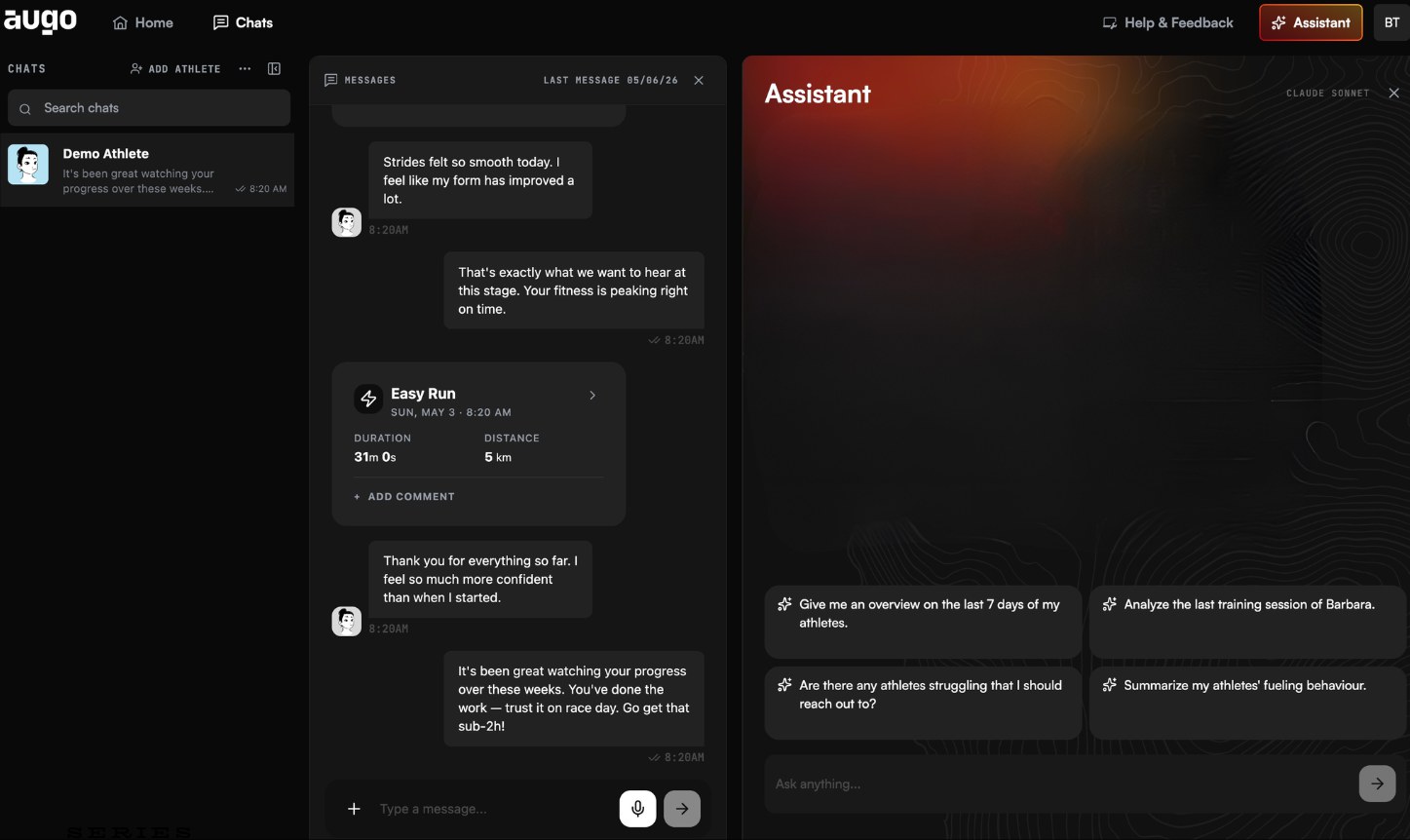
One thing it deliberately does not do: write your training plans or make decisions for you. We believe that's the coach's job — and we've written at length about where AI training plans stop being useful.
Subjective data that athletes will actually share — including via voice
Every coach knows subjective data is the highest-value input they have. Almost every platform treats it as a text box nobody fills in.
augo gives coaches ten questions to choose from — intensity, nutrition, motivation, whether the session met expectations, and more — attached to every session. Athletes can add context in writing or by voice, and voice notes are automatically transcribed. That matters twice: it's fast enough that athletes actually do it, and it's readable by the assistant, so a rambling 40-second voice note after a long run becomes searchable, trendable coaching data instead of an audio file you never open.
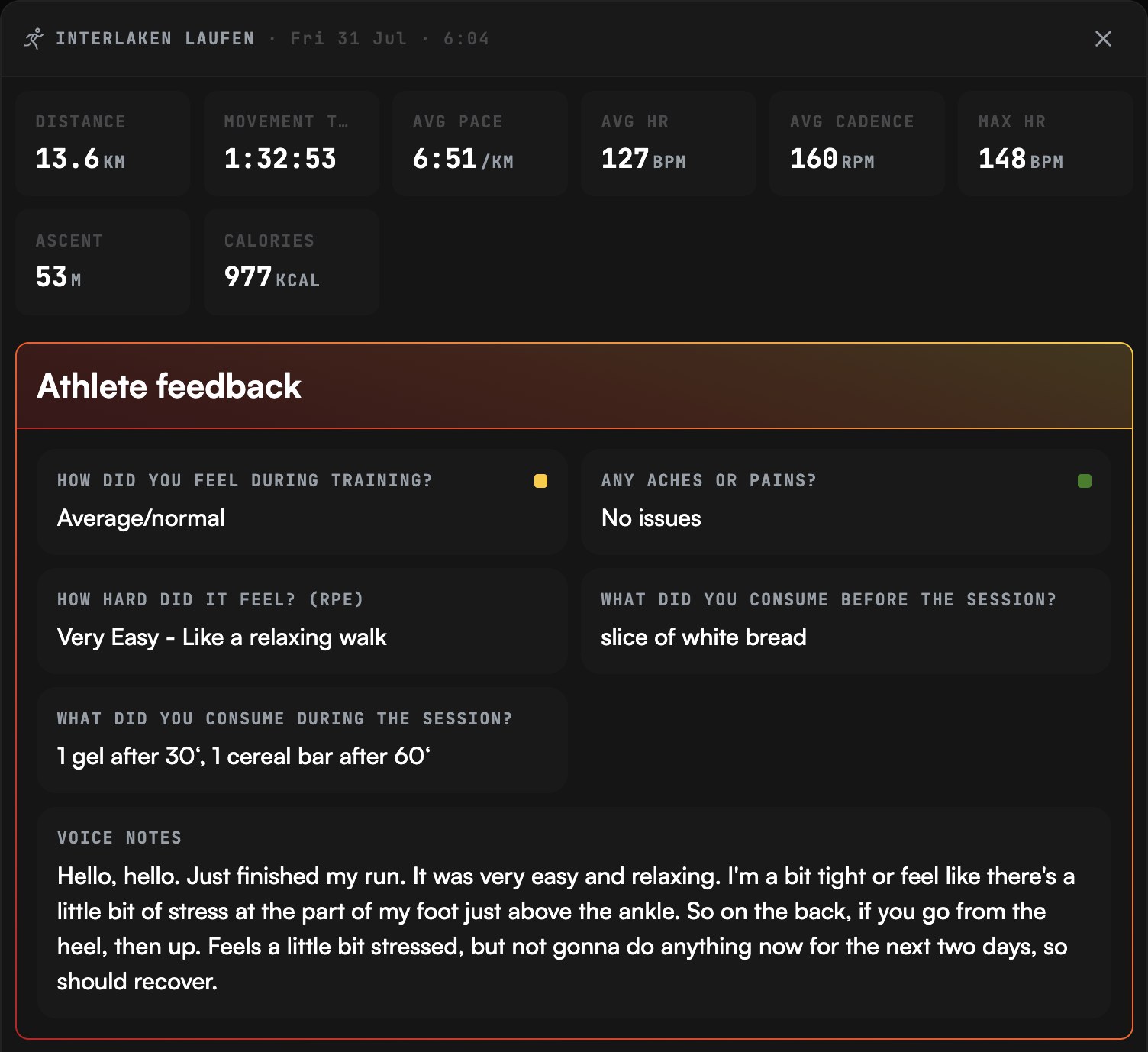
Trend views then show how an athlete has felt over time, and whether pains and niggles are recurring — which is exactly the signal that gets lost in a training calendar. If you want the longer argument for why this matters, we wrote it up in the search for athlete context.
One place for chats and workouts
augo has 1:1 athlete chat, and workouts appear inside the conversation. Coach and athlete are looking at the same session while they talk about it.
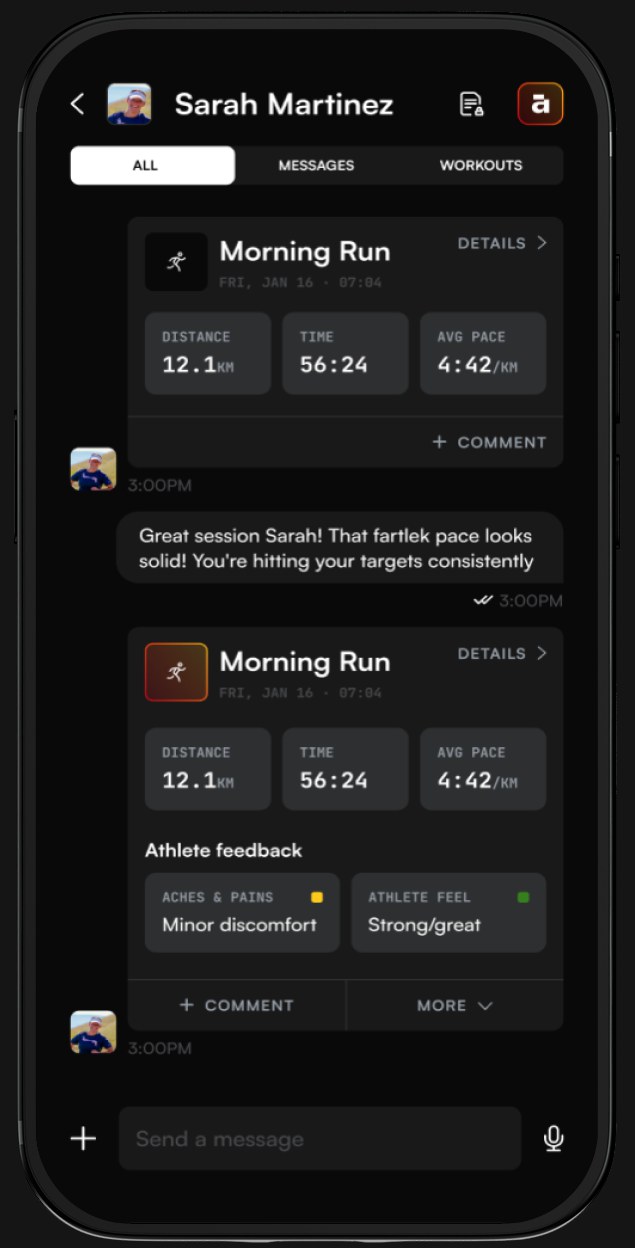
This is the part that replaces the stack most coaches are actually running: WhatsApp for the conversation, email for the admin, a notes app for the context, and the training platform for the data. augo collapses that into one place — which also means the AI can read all of it, which is the whole point.
Mobile-first, not mobile-also
augo started on mobile. There is native iOS and Android, and everything described above works on mobile exactly as it works on web. No reduced coach view, no "log in on desktop to do that". You can triage your roster, read signals, interrogate the assistant, write notes and message athletes from your phone between sessions.
This is the single biggest day-to-day difference coaches report when they switch, and it's structural rather than cosmetic. Products built desktop-first and ported to mobile behave like ported products forever.
augo vs TrainingPeaks: full feature comparison
| Feature | TrainingPeaks | augo |
|---|---|---|
| Built for | The metrics-first coach modelling load and form | The coach who wants the full picture of how athletes are doing |
| Core philosophy | Give the coach more data and better charts | Read the data for the coach and surface what matters |
| Primary interface | Desktop-first, ported to mobile | Mobile-first, full parity on web |
| Coach features on mobile | Partial | Complete — everything works on mobile |
| CTL / ATL / TSB (PMC) | ✅ Industry standard | ❌ Deliberately not offered |
| TSS / training-load modelling | ✅ Deep | ❌ |
| Power, HR, pace, laps, intervals, streams, curves | ✅ | ✅ |
| Workout splits and graphs | ✅ Extensive | ✅ |
| Deep chart-based analysis | ✅ Best in class | ❌ By design — the assistant reads the data instead |
| AI assistant across full athlete context | ❌ | ✅ Workouts, feedback, conversations, anchors, private notes |
| Roster-wide AI triage (Athlete Signals) | ❌ | ✅ Daily, last 7 days, every athlete |
| AI drafting (messages, summaries, comments) | ❌ | ✅ |
| AI takes actions (creates notes, records anchors) | ❌ | ✅ |
| AI writes training plans | ❌ | ❌ Intentionally left to the coach |
| AI on the athlete's side | ❌ | ❌ Intentionally — the coach stays in control |
| Structured subjective session feedback | Basic comments | ✅ 10 selectable questions per session |
| Voice feedback, auto-transcribed | ❌ | ✅ |
| Wellbeing / niggle trend views | Limited | ✅ |
| Coach private notes | ✅ | ✅ — and readable by the assistant |
| 1:1 chat with workouts in-thread | Basic messaging | ✅ |
| Workout prescription / plan builder | ✅ Mature | ✅ |
| Training plan marketplace | ✅ Largest in the sport | ❌ |
| WKO integration | ✅ | ❌ |
| Device integrations | Garmin, Wahoo, Polar, Strava, Zwift and more | Garmin, Strava, Coros, Wahoo, Zwift, Polar |
What augo does not do (yet)
No CTL, ATL, TSB or Performance Management Chart. This is a deliberate product decision, not a gap we're embarrassed about — but if the PMC is how you plan a season, augo will feel like it's missing a limb. Be clear with yourself about that before you switch.
No deep chart-based analysis. augo shows workout splits and graphs, but it does not try to out-chart TrainingPeaks. The bet is that an AI assistant reading every stream, every subjective report and every conversation surfaces more useful conclusions than a coach manually cross-referencing six charts. That's a bet. Some coaches won't take it.
No plan marketplace, no WKO. If you sell plans through the TrainingPeaks marketplace, that's a real business dependency and augo doesn't replace it.
Workout prescription has shipped. augo is now a full replacement for most coaches rather than a layer around your training platform — it takes over the conversation, the subjective data, the notes, the triage and the athlete relationship, while prescription still happens where it happens today. From September, that gap closes.
Who's behind augo
augo was founded by Bruna, a former elite tennis player, running coach and data scientist, Fabienne, a triathlete, coach and business analyst, and Andreas, a triathlete and software engineer, and is advised and supported by people who know this problem from the inside:
- Dr. Marco Altini: founder of HRV4Training, 50+ peer-reviewed publications on physiology and wearables, data science advisor to Oura, guest lecturer in Human Movement Sciences at Vrije Universiteit Amsterdam. Arguably the person most responsible for coaches taking subjective and autonomic data seriously.
- Gordon Crawford: Director of Performance at Triathlon Ireland, previously National Elite and U23 Coach and Director of the National Training Centre at Swiss Triathlon through the Tokyo Olympic cycle.
- Reto Brändli: Swiss coach to professional triathletes including Imogen Simmonds and Anne Reischmann, running coaching at a performance lab spun out of Zurich's technical institute.
Metrics-driven people, backing a product that argues metrics alone aren't enough. That's not a contradiction: it's the whole point.
So which one should you choose?
Stay on TrainingPeaks if: you plan seasons on the PMC, you live in WKO, you sell plans through the marketplace, or your coaching philosophy is fundamentally load-modelling. It's the best tool in the world for that and nothing here beats it.
Switch to augo if: you coach humans at scale and your bottleneck is attention, not analysis. If you're already running WhatsApp plus a training platform plus a notes app and losing things between them. If you want AI working for you — reading everything, triaging your roster, drafting your follow-ups — instead of a chatbot bolted onto a dashboard. If you want to coach from your phone.
Frequently asked questions
Is augo a full replacement for TrainingPeaks?
Yes, for most coaches. Workout prescription has shipped, so augo now covers the plan as well as everything around it: the conversation, subjective feedback, notes, triage and analysis. augo does not offer CTL/ATL/TSB or a plan marketplace, and doesn't intend to.
Does augo have CTL, ATL and TSB?
No, deliberately. augo gives you power, heart rate, pace, intervals, laps, curves and streams, plus subjective feedback, and uses an AI assistant to interpret them together. If the Performance Management Chart is central to how you coach, TrainingPeaks remains the better fit.
Does the AI coach my athletes for me?
No. augo's assistant does not write training plans, and there is no AI on the athlete side at all. That's intentional. Insights go to the coach, so athletes don't act on AI output without you. augo is built to make coaches more efficient and effective, not to replace them. We've made the longer version of that argument here.
Can athletes give feedback by voice?
Yes. Written or voice, on every session. Voice is transcribed automatically, so it's readable by you and by the assistant, and it feeds the trend views.
Does augo work on mobile?
augo started on mobile. Native iOS and Android, with complete feature parity with web for both coaches and athletes.
Which devices does augo sync with?
Garmin, Strava, Coros, Wahoo, Zwift and Polar.
Does Garmin's acquisition of TrainingPeaks change anything for coaches?
Garmin announced the acquisition of TrainingPeaks and TrainHeroic on 22 July 2026 and said the platform will continue to operate as a cross-platform ecosystem. Nothing has changed for coaches yet. The open question is long-term device neutrality now that a hardware manufacturer owns the platform — which is why coaches with athletes on Wahoo, Coros, Polar or Suunto are reviewing their options. augo is device-neutral and has no hardware business — we set out our full position on the acquisition here.
Try it with your own athletes
The fastest way to judge a coaching platform is to point it at a real roster and see what it finds.